Pool builders outgrow spreadsheets when disconnected files and manual updates can no longer keep up with the business. As lead volume, estimates, schedules, change orders, and job costs become more complex, spreadsheets make it harder to stay accurate, organized, and profitable.
Spreadsheets can work for simple lead lists, estimate templates, and basic job tracking. But growing pool companies usually need a more connected system for estimating, project management, job costing, customer communication, and reporting.
That does not mean spreadsheets are useless. Most pool builders use them for a reason. They are familiar, flexible, and easy to start with. But at some point, the same spreadsheet that helped you stay organized in the beginning can become the thing slowing the business down.
For growing pool companies, the issue usually is not one single spreadsheet. It is the pile of spreadsheets, notes, texts, emails, folders, and “ask so-and-so” processes that build up over time. The work gets done, but it takes too much effort to keep everything accurate.
That is usually the point where a pool builder starts needing something more reliable than spreadsheets. Pool construction software, like ProDBX, can help organize your company to become more efficient across office and field work.

Spreadsheets Work Until the Business Starts Growing
In the early days, spreadsheets can make a lot of sense.
You might have one spreadsheet for leads, another for estimates, another for pricing, and another for job tracking. If the company is small and only one or two people are managing most of the details, that can work for a while.
The problem starts when more people get involved.
Sales needs to know which leads need follow-up. Estimators need current pricing. Project managers need updated schedules. Office staff needs to know what has been approved, billed, or changed. Owners need visibility into what is happening without chasing everyone down for updates.
A spreadsheet can store information, but it does not really manage the process.
It will not remind someone to follow up with a lead. It will not warn you that a pricebook is outdated. It will not automatically connect an approved change order to the job cost. It will not give the whole team one shared view of the customer, estimate, project, and financials.
That is where spreadsheets start to fall short.
Spreadsheet vs. Pool Construction Software
| Business Need | Spreadsheet | Pool Construction Software |
|---|---|---|
| Lead tracking | Manual list of leads and notes | CRM-style pipeline with follow-up visibility |
| Estimating | Templates, formulas, and copied files | Centralized estimating process and pricebook |
| Price updates | Manual updates across files | More controlled pricing and item management |
| Project scheduling | Static schedule that must be updated manually | Shared project visibility for the team |
| Change orders | Tracked separately or manually | Connected to the job and customer workflow |
| Job costing | Often reviewed after the job | Better estimated vs. actual cost visibility |
| Communication | Emails, texts, calls, and notes | Project information stored in one place |
| Reporting | Manual reports and spreadsheet cleanup | Easier visibility into sales, jobs, and performance |
| Scalability | Harder as volume and staff grow | Built for repeatable processes |
The Signs a Pool Builder Has Outgrown Spreadsheets
Most pool builders do not outgrow spreadsheets overnight. It usually happens slowly. At first, the spreadsheet is just a little messy. Then estimates take longer, pricing gets harder to trust, leads get missed, and the owner has to keep asking the team for updates.
Here are some of the clearest signs that spreadsheets are starting to slow the business down.
- Estimates Take Too Long to Build
- Pricebook Updates Are Hard to Control
- Leads Start Falling Through the Cracks
- Project Schedules Change Faster Than the Spreadsheet
- Change Orders Become Hard to Track
- Job Costing Is Always Behind
- Everyone Has a Different Version of the Truth
Where Spreadsheets Start to Break Down
Spreadsheets usually break down in five key areas: sales, estimating, project management, job costing, and reporting.
Sales
Sales teams need more than a list of names. They need to know where each lead stands, what has been discussed, when the next follow-up is due, and what needs to happen next.
A spreadsheet can track some of that, but it requires constant manual updates. If the team is busy, those updates often get skipped.
That leads to missed opportunities.
Estimating
Estimating needs consistency. Pool builders need accurate pricing, clear options, standard templates, and controlled margins.
Spreadsheet estimating can work, but it depends heavily on the person using the spreadsheet correctly every time. That leaves too much room for errors, especially when multiple people are quoting jobs.
Project Management
Pool construction has a lot of phases and a lot of handoffs.
The team needs to know what has been completed, what is scheduled next, what is delayed, and what needs attention. Spreadsheets can become outdated almost as soon as they are updated.
Project management needs to be active, not static.
Job Costing
Job costing is hard to manage in spreadsheets because the real costs usually live in multiple places. Without a connected system, it takes extra work to understand whether a job is on budget.
That makes it harder to protect margins.
Reporting
Owners need clear answers.
How many leads came in this month? How many estimates were sent? How many jobs were sold? Which projects are behind? Which jobs are over budget? Which sales reps are producing? Which job types are most profitable?
If the answer requires someone to build a spreadsheet report manually, the business does not have real-time visibility.
The difference is simple: spreadsheets store information, while pool construction software helps manage the workflow.
That matters because a pool builder is not just tracking data. The company is moving customers, estimates, crews, costs, schedules, and projects through a process.
What Pool Builders Need Instead of More Spreadsheets
When a pool builder outgrows spreadsheets, the answer is not usually a better spreadsheet.
It is a better system.
A growing pool company needs one place to manage the core parts of the business: leads, estimating, projects, job costing, change orders, and reporting.
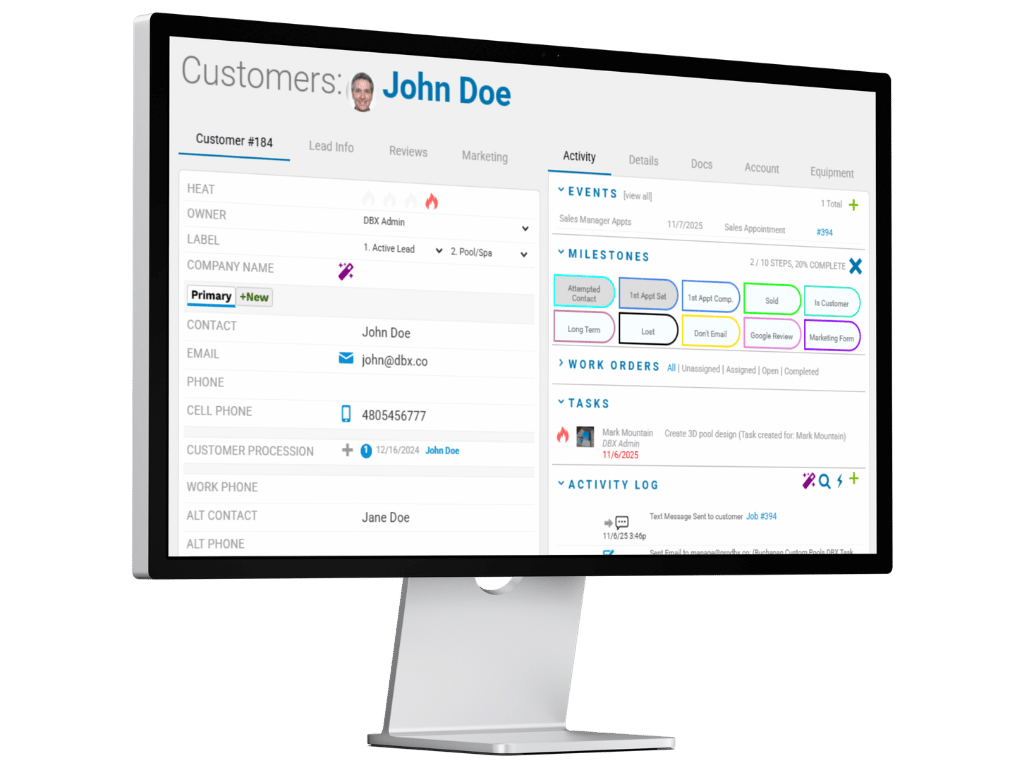
A Central CRM for Pool Leads
Pool builders need to know exactly where every lead stands.
A good system should help track new leads, follow-ups, appointments, estimates, and sales opportunities. It should make it easier for the team to know who needs attention and what the next step is.
That is hard to do consistently with a spreadsheet.
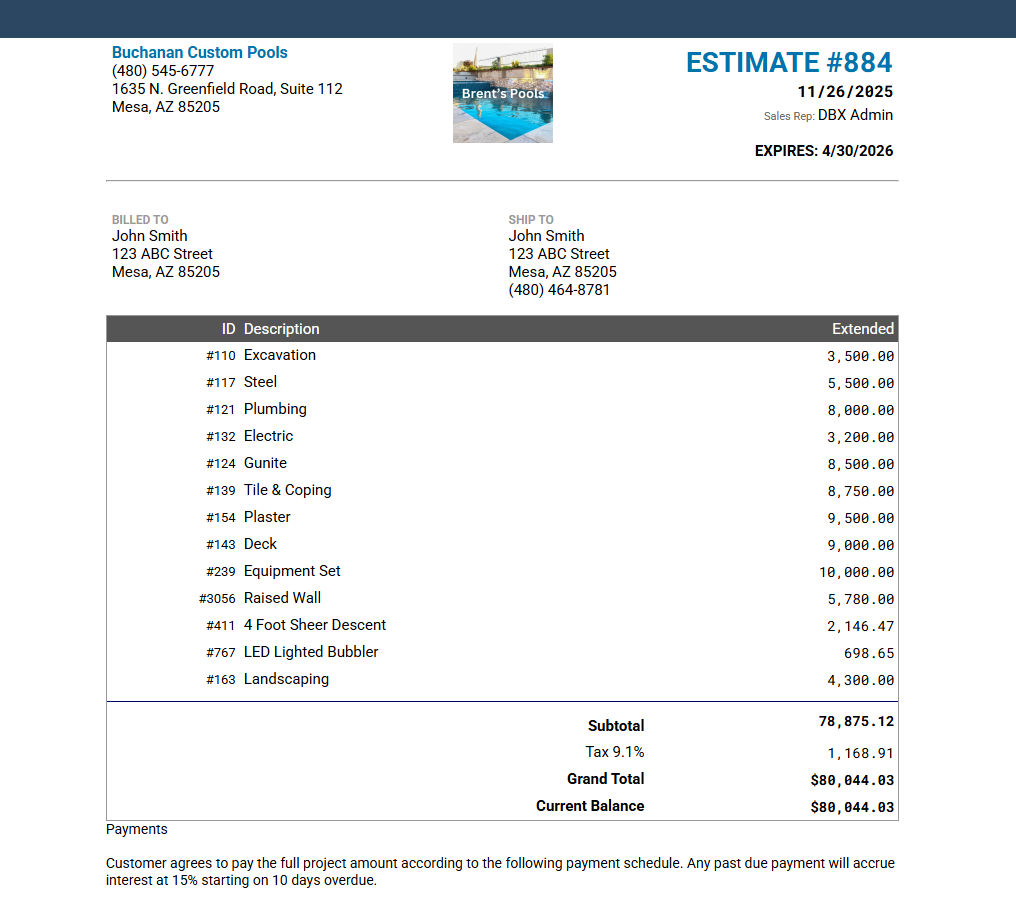
A Repeatable Estimating Process
Estimating should not depend on copying the right old file or hoping the formula is still correct.
Pool builders need a repeatable way to build estimates using current pricing, standard options, and consistent margins. This helps the team quote faster and reduces the chance of missing important costs.
The goal is not just faster estimating. It is more consistent estimating.
Project Management Built Around Pool Construction
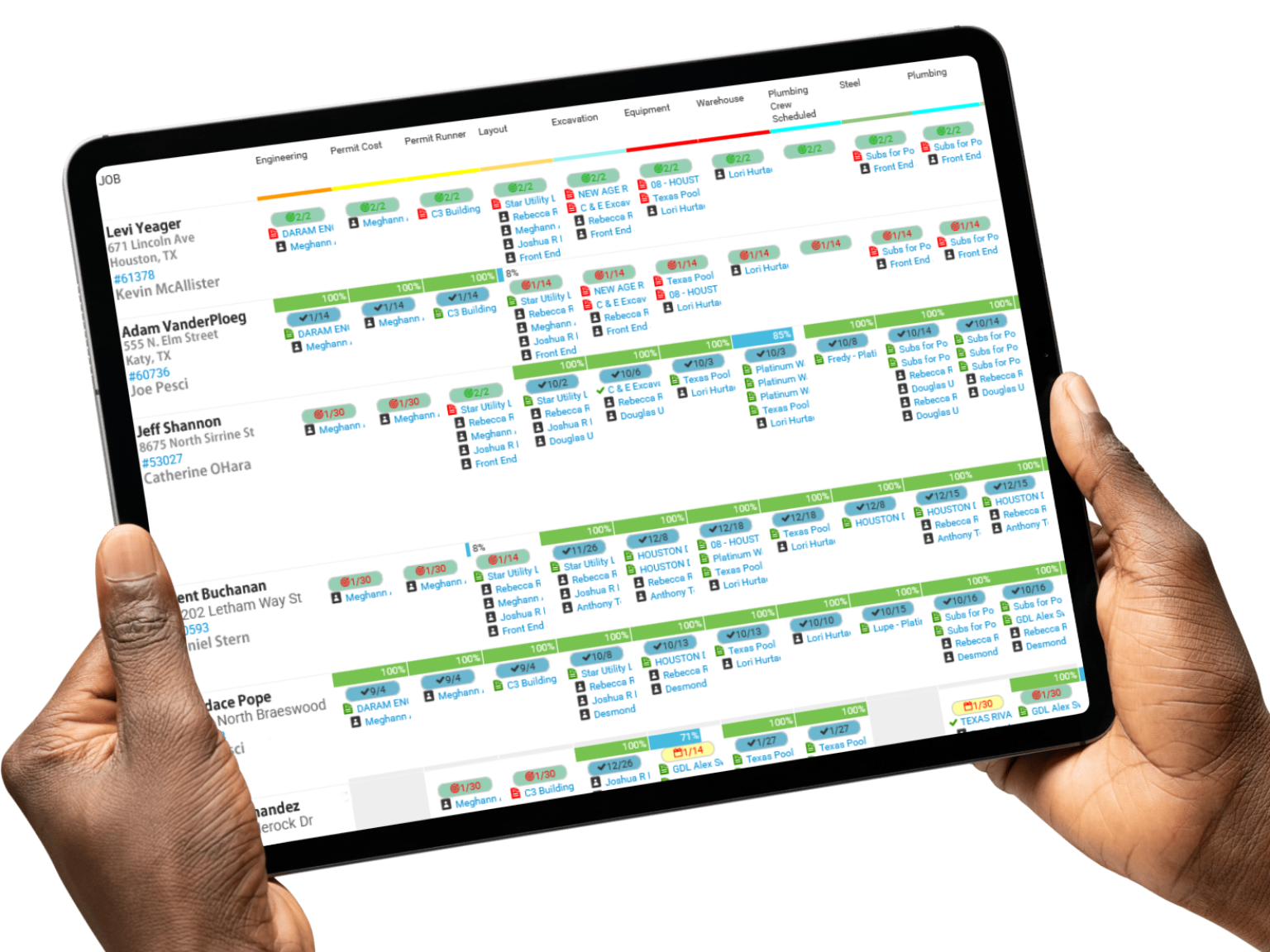
Pool projects have phases. They have crews, subs, inspections, materials, customer updates, and schedule changes.
A growing pool builder needs project management that matches how pool construction actually works. The team should be able to see where a job stands, what is coming next, and what needs attention.
That is difficult when project updates are spread across spreadsheets, emails, texts, and phone calls.
Job Costing That Shows Profitability
Pool builders need to know whether jobs are actually making money.
That means comparing estimated costs to actual costs and understanding where margins are being won or lost. Without good job costing, a builder may stay busy without realizing certain job types, options, or processes are hurting profitability.
A connected system makes job costing easier to manage because the information is tied back to the job.
Change Order and Invoice Visibility
Change orders should be easy to document, approve, track, and bill.
When they are managed outside the main job workflow, it becomes too easy for something to slip through. A strong system helps protect revenue by making sure changes do not get lost in the shuffle.
One Place for the Whole Team to Work
This is the real goal.
A pool builder does not just need another tool. The company needs one reliable place for the team to work from.
When everyone is looking at the same information, the business runs cleaner. Sales knows what was quoted. Production knows what was sold. The office knows what needs to be billed. The owner can see what is happening without asking for manual updates all day.
That is the difference between running the business through spreadsheets and running the business through a system.
When Should a Pool Builder Upgrade From Spreadsheets?
A pool builder should consider upgrading from spreadsheets when manual tracking starts causing missed leads, inconsistent estimates, outdated pricing, scheduling confusion, missed change orders, or unclear job profitability.
Here are some common signs it is time:
- You are not sure every lead is getting followed up with.
- Estimates take too long to create.
- Different sales reps use different estimate templates.
- Pricing updates are hard to manage.
- You are worried about outdated costs or broken formulas.
- Change orders are being tracked manually.
- The team is relying too much on texts, calls, and emails for project updates.
- Job costing is only reviewed after the job is complete.
- The owner has to ask multiple people for basic updates.
- Reports take too much time to create.
- You are hiring more people and need better processes.
- You are growing, but the business feels harder to control.
If several of these sound familiar, the problem may not be the team. The problem may be the system the team is forced to use.
How ProDBX Helps Pool Builders Move Beyond Spreadsheets
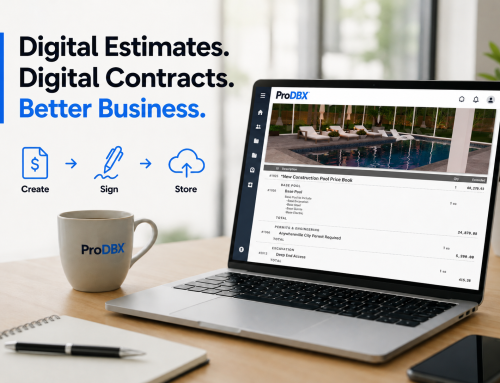
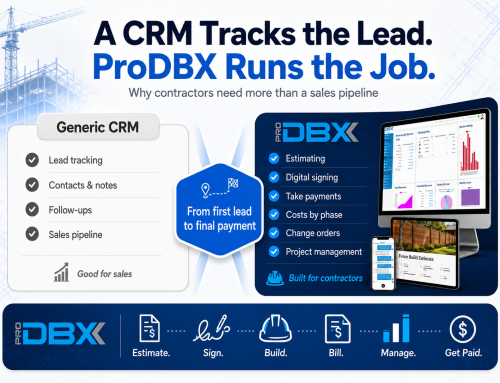
ProDBX helps pool builders replace disconnected spreadsheets with one platform for managing leads, estimating, projects, job costing, and day-to-day workflows.
Instead of using separate files for sales, estimating, scheduling, production, and job tracking, ProDBX gives pool contractors a more centralized way to manage the business from first lead to completed project.
Lead Tracking
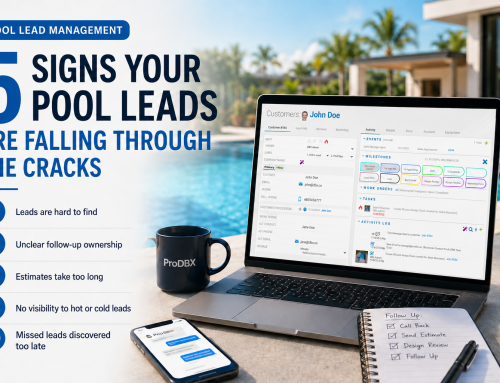
ProDBX helps pool builders keep better track of leads and sales opportunities so fewer prospects fall through the cracks. Instead of relying on a spreadsheet lead list, the team can manage customer information and sales activity in one place.
Pool Estimating
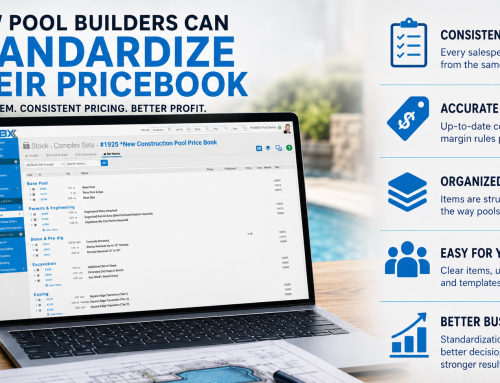
ProDBX gives pool builders a more consistent way to create estimates and manage pricing. This helps reduce the problems that come from copied spreadsheets, outdated templates, and manual formula errors.
For pool companies that want to quote faster and protect margins, a better estimating process can make a major difference.
Project Management
ProDBX helps pool builders manage projects with better visibility across jobs, phases, and team activity. This makes it easier to see what is happening without digging through emails, texts, and separate tracking sheets.
Job Costing
ProDBX helps pool builders track job costs more clearly, so owners and managers can better understand estimated vs. actual costs and protect profitability.
For growing pool companies, this is one of the biggest reasons to move beyond spreadsheets. It is hard to improve margins if you cannot clearly see where the money is going.
A More Connected Business
The biggest benefit is connection.
When leads, estimates, projects, change orders, and job costs are managed in separate spreadsheets, the business becomes harder to control. When those pieces are connected, the team has better visibility and the owner has a clearer picture of what is happening.
That is what growing pool builders need.
Frequently Asked Questions
Why do pool builders use spreadsheets?
Pool builders use spreadsheets because they are familiar, inexpensive, and easy to customize. They can work well for simple lead lists, estimate templates, pricing sheets, and job tracking when the company is small. As the business grows, spreadsheets become harder to manage because they rely on manual updates and disconnected files.
What are the biggest problems with spreadsheets for pool builders?
The biggest problems are manual data entry, outdated pricing, version control issues, missed follow-ups, slow estimating, disconnected project information, missed change orders, limited reporting, and poor job cost visibility.
When should a pool builder stop using spreadsheets?
A pool builder should consider moving beyond spreadsheets when the team is losing time updating files, missing follow-ups, struggling to keep estimates consistent, tracking change orders manually, or lacking a clear view of job profitability.
What is better than spreadsheets for managing a pool construction business?
Pool construction software is better than spreadsheets for growing pool builders because it connects lead tracking, estimating, project management, change orders, job costing, and reporting in one system.
Can small pool builders use pool construction software?
Yes. Small pool builders can use pool construction software to create better processes earlier. Even if the team is small, having a consistent system for leads, estimates, jobs, and costs can help the company grow without creating messy habits that are harder to fix later.
Does pool construction software replace accounting software?
No. Pool construction software usually manages the operational side of the business, such as leads, estimates, projects, change orders, and job costing. Accounting software manages the financial records. Many pool builders use both, especially when they want their operations and accounting to work together more smoothly.
Final Thoughts
Spreadsheets are often a good starting point for pool builders. They are simple, flexible, and easy to use when the business is small.
But as the company grows, spreadsheets can become a bottleneck.
The signs are usually easy to spot: estimates take too long, pricing gets harder to control, leads fall through the cracks, schedules become confusing, change orders get missed, and job costing is always behind.
At that point, the business does not need more spreadsheets. It needs a better way to manage the work.
ProDBX helps pool builders move beyond disconnected files by giving them one place to manage leads, estimates, projects, job costing, and the workflows that keep the business moving.
Ready to move beyond spreadsheets? See how ProDBX helps pool builders quote faster, manage projects more clearly, and track job profitability from one connected system.